
The Truth about Charleston Weather
When people dream about moving to the Charleston area, they are usually visualizing sunny, 75 degree days, a light ocean breeze, and a polo shirt weather environment that lasts all year.
Contact me directly if you want a summarized version of all this!
And look, we absolutely get those days—they are the reason the Lowcountry is one of the fastest-growing regions in the country. But if you are seriously planning a move here, you deserve the unvarnished, data-backed truth about our subtropical climate.
The weather here is a major driver of the local lifestyle, real estate design, and even home maintenance schedules. Let’s pull back the curtain on what a full year in Greater Charleston actually feels like.
1. The "Second Spring": October & November
Let’s start with the absolute best-kept secret of Lowcountry living. While the rest of the East Coast is breaking out heavy winter coats and raking leaves, Charleston is experiencing its truest prime season.
The Reality: October and November bring clear, crisp blue skies with daytime highs averaging a comfortable 70°F to 78°F. The oppressive summer humidity completely breaks, leaving behind cool, refreshing mornings and evenings that are perfect for outdoor dining or a stroll down the Old Village in Mt. Pleasant.
The Local Lifestyle: Locals call this "The Second Spring." The tourist crowds thin out, the beaches are quiet, and the weather is flawless. It is arguably the most pleasant window of the entire year.
2. The Summer "Muggy" Marathon: June through August
If you are relocating from the Northeast, Midwest, or West Coast, this is the stretch that requires the biggest mental adjustments. Keep in mind everything indoors has AC, so as long as you aren’t raking leaves at Noon in July or August, you should be fine.
Average July High: 91°F | Average Relative Humidity (AM): 88%
The Heat Index Illusion: Don't let a forecast of 91°F fool you. In July and August, our dew points routinely sit in the mid-to-upper 70s. This creates a thick, tropical blanket of air where the heat index (what it actually feels like) easily climbs past 100°F.
The Afternoon Rhythm: Summer days follow a predictable cycle: bright, intense morning sun, followed by a sudden, heavy thunderstorm around 4:00 PM driven by the sea breeze, which temporarily cools things down before turning the evening into a literal sauna.
Real Estate Impact: In Charleston, your HVAC system is the most important appliance in the house. Well-insulated homes with high-efficiency heat pumps and proper crawlspace moisture control (like encapsulation and dehumidifiers) are absolute musts to protect properties from the ambient summer moisture. Ask me about how we make sure the home you buy has everything it needs to keep moisture & mold OUT!
3. The Mild, "Blink-and-You-Miss-It" Winter
If you are tired of shoveling snow, scraping ice off windshields, and gray, slushy streets, Charleston's winter will feel like an absolute vacation.
The Reality: January is our coldest month, but with an average daytime high of 59°F to 61°F, "cold" is entirely relative. You will see locals walking downtown in light fleece jackets or sweaters. Snow is a historic rarity; a few flurries might happen once every half-decade, and when they do, the city happily shuts down for a day to enjoy the novelty. We did have about 4-5” of snow fall the Winter of 2024-2025 and 2-3” of snow fall the Winter of 2025-2026, and both those Winters were colder than normal in general (but honestly those were some of the best days as we pulled sleds behind golf carts, and the kids LOVED it).
The Caveat: We do get occasional morning freezes where temperatures drop into the 30s. If you have a yard filled with delicate coastal landscaping like citrus or certain palm varieties, you'll need to keep some burlap on hand to wrap them for a night or two.
4. The Spectacular Spring Burst: March to May
Spring arrives early in the Lowcountry, usually kicking off in early March. It is an explosion of color, but it comes with one specific catch.
The Visuals: This is the window when the historic downtown peninsula and neighborhoods like I'On look exactly like a postcard. Azaleas, jasmine, and wisteria bloom simultaneously, filling the air with an incredible fragrance. Temperatures climb beautifully into the 70s and low 80s. The Confederate Jasmine (also called Star Jasmine) is an intoxicating smell, especially where it’s highly concentrated downtown and is the most beautiful smells in the world – April/May).
The "Green Coating": For about two to three weeks in late March or early April, pine pollen takes over. Everything—your car, your porch furniture, your driveway—will be covered in a fine layer of chartreuse dust. It is a brief rite of passage that local homeowners tackle with a quick pressure-washer session.
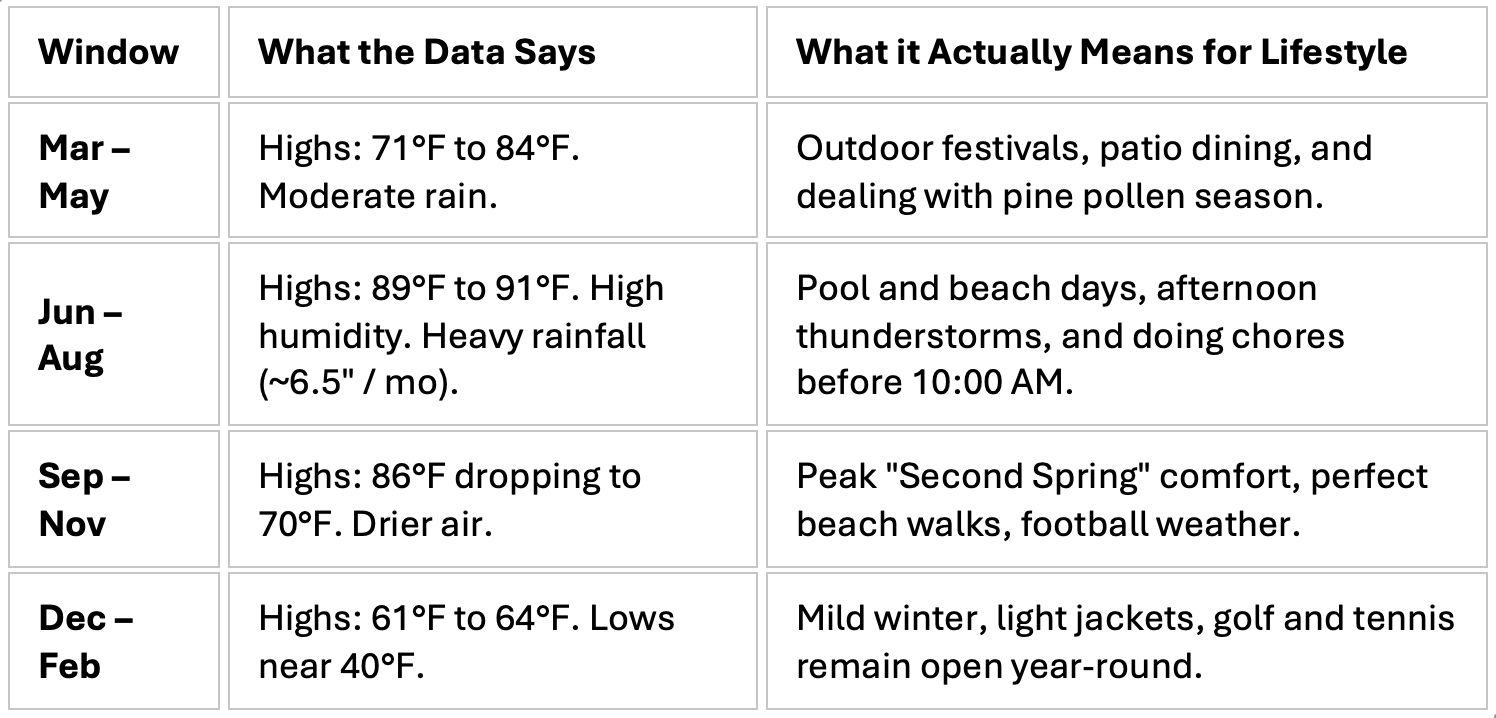
The Master Weather Calendar
The Hurricane Elephant in the Room: Atlantic hurricane season runs from June 1 through November 30, with the historical peak hitting between mid-August and late September. While major storms are rare, localized coastal flooding during exceptionally high tides (known as "King Tides") combined with heavy summer rain is a real part of Lowcountry life. When looking at real estate, understanding a home's elevation certificate, flood zone classification, and structural construction is just as important (actually MORE important) as looking at the kitchen countertops. I can guide you to make sound decisions as it pertains to hurricanes and flooding, as that was one of my greatest fears when I moved to Charleston (btw, I don’t even think about it anymore).
Summary – What’s the deal w/ Charleston Weather?
The Best Season ("Second Spring"): October and November offer the most flawless weather of the year, with clear blue skies, crisp air, and comfortable daytime temperatures ranging from the low-to-high 70s.
The Intense Summer: June through August brings tropical humidity and heat indices that easily push past 100°F. Days typically feature bright mornings followed by heavy, brief 4:00 PM thunderstorms. This environment requires high-efficiency HVAC systems and active home moisture control (like crawlspace encapsulation).
The Mild Winter: December through February is exceptionally gentle. January highs average around 60°F, requiring nothing more than a light jacket. Snow is incredibly rare, though a handful of overnight freezes occur.
The Pollen-Heavy Spring: March through May delivers postcard-perfect landscapes filled with blooming azaleas and jasmine, alongside a brief 2-to-3-week window where pine pollen coats outdoor surfaces in green dust.
The Coastal Reality: Hurricane season (June–November) and exceptionally high "King Tides" mean that understanding a home's elevation, structural build, and flood zone is a vital part of local property ownership.
Call or Text: 617.733.4240
Email: CharlestonLivingGroup@gmail.com
Learn More & Meet Mark: www.theCharlestonLivingGroup.com