
Downtown Neighborhoods - Inside vs Outside The Crosstown
When you are shopping for real estate on the Charleston peninsula, you will quickly hear locals and agents use a specific phrase that acts as the ultimate geographical dividing line: "Inside the Crosstown" versus "Outside the Crosstown."
The Crosstown (the segment of US-17 that cuts horizontally across the upper neck of the peninsula) splits downtown Charleston into two distinct real estate realities. Where a home sits relative to this highway dictates its price per square foot, its architectural style, its flood dynamics, and its overall lifestyle vibe.
Contact me directly if you want a summarized version of all this!
If you are looking to secure a piece of the peninsula, understanding this geographic split is the single best way to avoid overpaying and to locate hidden value pockets.
1. "Inside the Crosstown": The Masterpiece Historic Districts
This is the area south of the highway. When people visualize horse-drawn carriages, gas lantern-lit gas lamps, and museum-quality 18th-century architecture, they are looking "Inside the Crosstown."
The Ultra-Desirable Core: South of Broad & The French Quarter
The Profile: This is the absolute premium tier of Charleston real estate. Houses here routinely trade north of $1,000 per square foot. South of Broad features grand antebellum mansions, private brick-walled gardens, and direct access to The Battery. The neighboring French Quarter is denser and more commercial, filled with historic lofts, pieds-à-terre, art galleries, and top-tier dining.
Real Estate Reality: Inventory is incredibly rare, and properties hold their value better than almost anywhere else in the state. However, homes here face strict Board of Architectural Review (BAR) oversight, and many low-lying streets are susceptible to tidal flooding (King Tides).
The Premier Residential Standard: Harleston Village & Ansonborough
The Profile: For buyers who want iconic historic single houses but require a highly functional neighborhood structure, these two pockets are the gold standard. Harleston Village wraps around the beautiful Colonial Lake and the College of Charleston campus, blending grand homes with tree-lined sidewalks. Ansonborough, sitting on the east side near the Cooper River, features stately brick townhomes and was the catalyst for the city’s historic preservation movement in the 1960s.
Flood Risks: Historically, the West side of the downtown peninsula tends to flood more than any other part of downtown. If looking at Harleston Village, keep that in mind and ask us about where those flood-prone streets tend to see the most water problems.
2. "Outside the Crosstown": The Upper Peninsula Infill & Local Hubs
Heading north past the highway takes you "Outside the Crosstown." Historically, this area was industrial or farmland. Today, it is the center of Charleston's modern urban design, trendy local businesses, and residential communities that bypass the heavy tourist traffic.
The Neighborhood Hubs: Wagener Terrace & Hampton Park Terrace
The Profile: Instead of 1700s single houses, these neighborhoods are anchored by early-to-mid 20th-century architecture: deep-porch craftsman bungalows, Tudor revivals, and brick cottages.
The Vibe: This area is highly favored by young professionals, medical personnel, and families. Life here centers around Hampton Park (the largest green space on the peninsula), neighborhood playgrounds, microbreweries, and highly rated local bistros that tourists rarely discover.
Real Estate Advantage: Many of these neighborhoods—particularly Hampton Park Terrace and parts of Wagener Terrace—sit on a natural high-top ridge of the peninsula. This means they are often located in FEMA Flood Zone X, offering a major reprieve from the high insurance costs found further south.
3. Finding the Value: Where to Look Next
If you want a peninsula lifestyle but find yourself priced out of a multi-million dollar South of Broad address, there are a few distinct pockets where smart buyers can find value.
Value Play 1: Cannonborough-Elliottborough (The Transition Zone)
Located just inside the southern boundary of the Crosstown, this neighborhood serves as the bridge between old-world Charleston and creative modern energy.
The Opportunity: While sections have seen immense restoration over the last decade, you can still find authentic Freedman's Cottages and classic Charleston single houses that require aesthetic updating. It is heavily walkable, packed with independent bakeries, design studios, and coffee shops, making it highly desirable for buyers who want an urban-adjacent lifestyle at a lower entry price point than Harleston Village.
Value Play 2: East Central & NoMo (The Growth Vector)
Located outside the Crosstown on the northeast side, this area is transitioning from light industrial and commercial use into a trendy innovation and tech sector.
The Opportunity: If you prefer clean, low-maintenance living, this is the peninsula's hub for modern townhouses, industrial-style condos, and fresh infill construction. It offers lower price tags per square foot, easy access to I-26 for commuting, and immediate proximity to the "Upper King" and NoMo dining scenes.
Value Play 3: North Central
Geographically, North Central sits squarely Outside the Crosstown. It is bordered by the highway to the south, Mt. Pleasant Street to the north, King Street to the east, and Rutledge Avenue to the west. Essentially, it is nestled right between the trendy Upper King commercial corridor and the quiet, oak-lined streets of Wagener Terrace.
For a prospective buyer trying to make a smart, risk-mitigated play on the peninsula, North Central plays a pivotal role.
Here is the unvarnished breakdown of how it fits into the broader downtown real estate puzzle.
1. The Value Play: The Price-per-Square-Foot Discount
North Central is arguably the most prominent "transition zone" on the upper peninsula.
The Baseline: While a historic home inside the Crosstown in Harleston Village or Ansonborough routinely commands $800 to over $1,000 per square foot, single-family homes in North Central pull that entry point down significantly, often trading closer to $500 to $600 per square foot.
The Market Dynamic: Market shifts have driven healthy price corrections here, bringing the median listing price down to around $775,000. It offers a crucial sweet spot: you still get an authentic peninsula streetscape and high walkability, but you aren't paying the crushing multi-million dollar premium attached to the historic districts further south.
2. The Architectural Vibe: Craftsman Meets Infill
You won’t find 18th-century brick mansions here. North Central's architectural identity is deeply rooted in the early-to-mid 20th century, heavily featuring:
Deep-porch Craftsman bungalows
Freedman’s cottages
Classic 1930s brick cottages
Because it has been a hotbed for revitalization over the last decade, North Central features a highly visible mix of beautifully restored historic properties sitting directly alongside ultra-modern, crisp architectural infill and newly constructed townhomes. It appeals heavily to a younger, local demographic—medical residents, tech professionals, and culinary insiders—who prefer a neighborhood that feels energetic rather than museum-like.
3. The Environmental X-Factor: Pockets of High Ground
Remember the rule about looking beyond the FEMA map? North Central highlights this perfectly.
Much of this neighborhood sits on the central ridge of the peninsula. This means large sections of North Central are designated in FEMA Flood Zone X (low-to-moderate risk).
The Real Estate Savings: Buying an older home in an AE flood zone downtown can mean spending thousands of dollars annually on flood insurance premiums alone. Finding a home on the high-ground pockets of North Central allows you to secure a historic raised foundation while drastically lowering your fixed carrying costs and structural moisture risks.
4. The Walkability Reality: The "Local's Upper King"
Inside the Crosstown, walkability means strolling to white-tablecloth tourist destinations or historic parks. In North Central, walkability takes on a decidedly more neighborhood-centric flavor.
You are within walking or golf-carting distance to what locals consider the true culinary hubs of the upper peninsula—spots like Leon's Oyster Shop, Melfi's, Rodney Scott's BBQ, and local neighborhood breweries. It offers an urban lifestyle where you don't have to battle the cruise-ship and tourism foot traffic found on Lower King Street.
Peninsula Comparison Matrix:
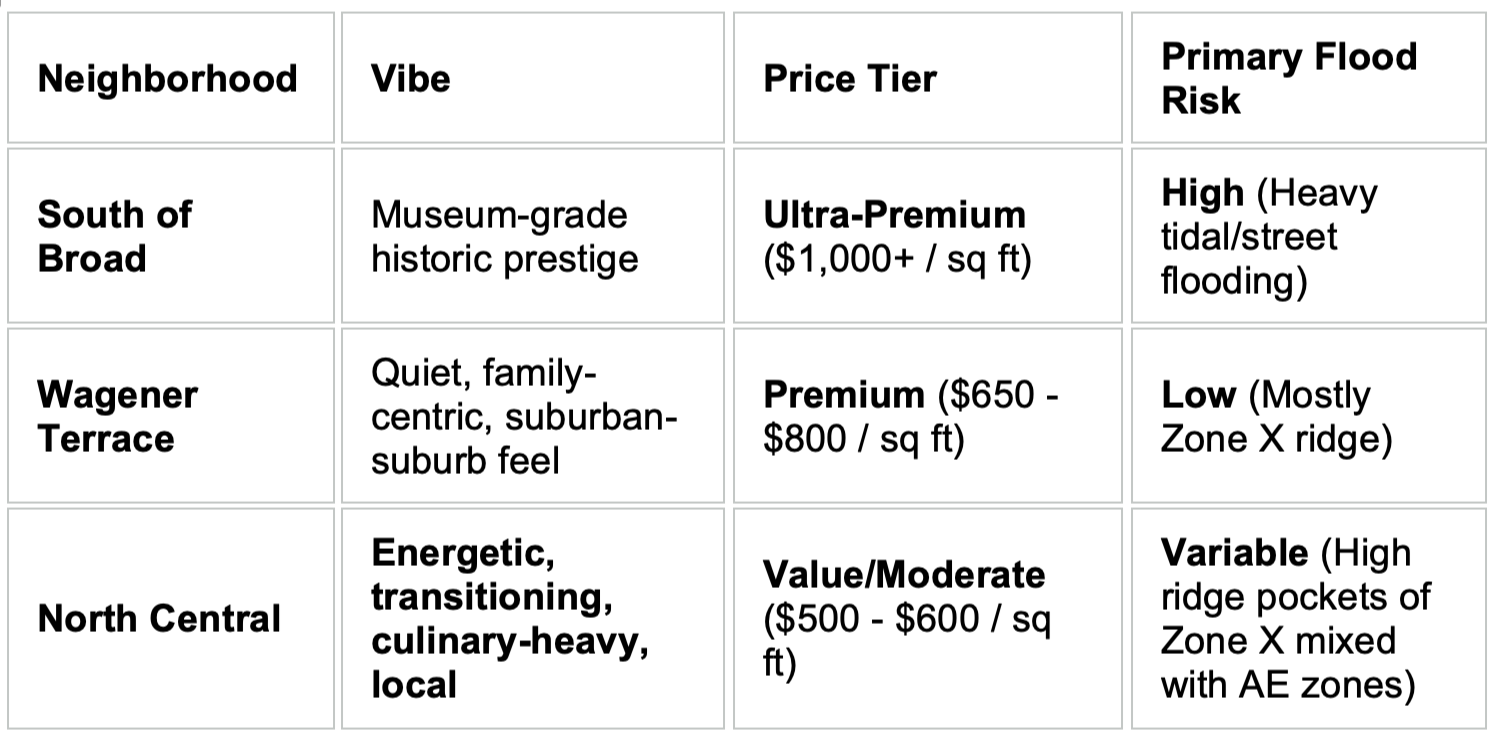
The Buyer's Strategy: The premium for moving "Inside the Crosstown" isn't just about square footage—it's an architectural premium. If your goal is structural history, walkability to historic steeples, and museum-grade finishes, look inside. If your goal is maximizing your budget, securing a yard, avoiding flood zones, and plugging into a local community, focus your search around Hampton Park or the transition streets right along the Crosstown corridor.
Summary & Buyer’s Strategy: Navigating the real estate landscape on the Charleston peninsula requires looking past the tourism brochures to understand how the city is geographically and culturally organized. For a prospective buyer, the peninsula is broken down into distinct residential micro-markets, fundamentally anchored by their position relative to the Crosstown Expressway (US-17). If your priority is architectural romance, strolls along the harbor seawall, and world-class fine dining, focus your search Inside the Crosstown. If your goal is to protect your budget, secure off-street parking, avoid flood zone premiums, and plug into a thriving local scene with strong long-term appreciation potential, focus your search Outside the Crosstown in pockets like North Central or Hampton Park Terrace.
Call or Text: 617.733.4240
Email: CharlestonLivingGroup@gmail.com
Learn More & Meet Mark: www.theCharlestonLivingGroup.com